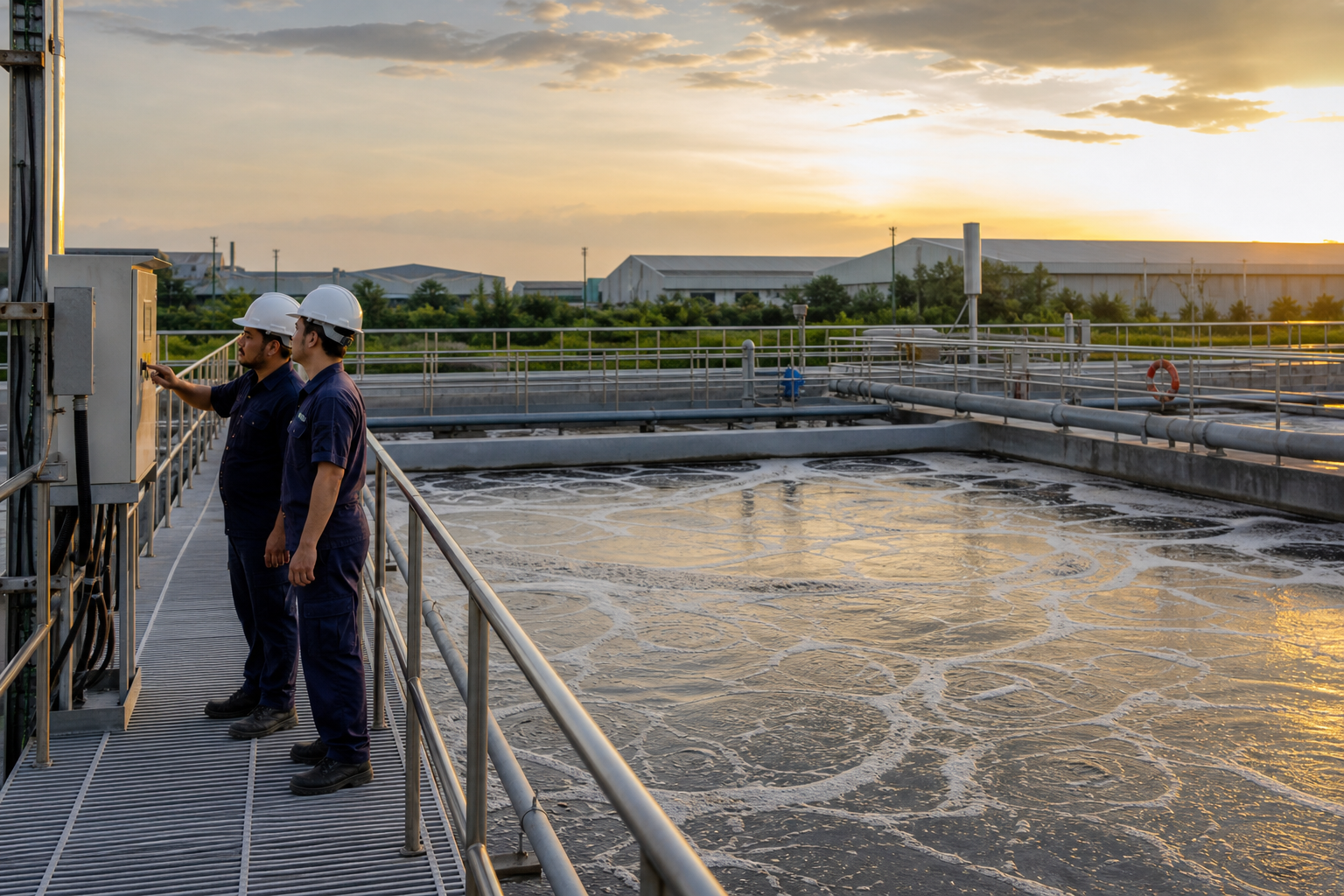
CFE (Establishment)
Site plan, pollution control design basis, and infrastructure readiness before build-out.
Regulatory content last reviewed 19 Mar 2026 · IE-RISE consultancy desk
Direct answer
Consent for Establishment (CFE) and Consent for Operation (CFO) are KSPCB authorisations under the Water and Air Acts: CFE addresses establishment-phase infrastructure and proposed pollution controls; CFO confirms operational readiness before routine production. In older practice, Consent to Operate (CTO) is often used interchangeably with CFO—confirm terminology against your current KSPCB portal labels. IE-RISE connects each application to your real capacity, utilities, effluent treatment plant (ETP) or sewage treatment plant (STP), stacks, and waste streams—not only portal fields.
Applicability for new units, expansions, or operational commissioning is confirmed against current rules and your project facts.
Use project stage and on-site readiness to choose the consent type IE-RISE should prepare. Both require consistent technical balances.
Stage / trigger: Greenfield or expansion civil works not yet operational
Typical consent focus: CFE — proposed process, layout, water balance, treatment design, emission sources
Stage / trigger: Plant built; pollution-control systems installed; ready to run
Typical consent focus: CFO — as-built alignment, commissioning evidence, monitoring plans
Stage / trigger: Operating under an old order; expiry approaching; no material change
Typical consent focus: CFO renewal — performance data and condition compliance
Stage / trigger: Process, capacity, fuel, or discharge changed after last order
Typical consent focus: Amendment (may precede or accompany CFO actions)
Under the Water (Prevention and Control of Pollution) Act and Air Act, Karnataka industries obtain Consent for Establishment (CFE) before setting up pollution control infrastructure and Consent for Operation (CFO) before routine production. KSPCB issues unified consent covering effluent, emissions, and hazardous waste schedules.
CFE proves that your Bangalore site plan includes adequate ETP/STP, stacks, fuel storage, and waste areas; CFO confirms those systems work and monitoring meets standards.
Clear separation of establishment and operation consent work for KSPCB.
Site plan, pollution control design basis, and infrastructure readiness before build-out.
Commissioning proof, monitoring, and operating consent before routine production.
Red/Orange/Green/White mapping and investment declarations aligned to Karnataka practice.
KSPCB online submission, annexures, and query closure.
CFE is required when establishing a new unit, relocating, or creating a distinct production block with pollution potential in Karnataka. Even green and white category registrations may need CFE when local bylaws, estate rules, or financiers require KSPCB proof.
Bangalore expansions in Peenya, KIADB parks, or IT park utility blocks should confirm CFE triggers before ordering long-lead equipment.
CFO is required before commercial operation at approved capacity—after commissioning tests on ETP, stacks, and DG sets. Operating without CFO exposes units to enforcement, including show-cause and closure directions, and blocks formal renewals.
Staged commissioning common in Bengaluru townships needs clear CFO strategy per phase.
Applications file online with fees based on category and capital investment. KSPCB regional offices review technical annexures, may site-visit, and issue queries before grant.
IE-RISE manages the full cycle: pre-application checklist, submission, query response, and post-grant condition interpretation for your operations team.
Typical packages include layout plans, process flow diagrams, water balance, material balance, emission sources list, hazardous waste inventory, undertaking letters, and pollution control equipment specs. Apartments add STP hydraulics and sewage disposal mode; hospitals add BMW tie-ups.
We tailor document lists to your Red, Orange, Green, or White classification so nothing is missing at upload.
KSPCB categorisation drives application format, fees, and inspection intensity. Misstated processes or hidden solvent use can reclassify a unit upward after inspection.
We benchmark SIC/process descriptions against Karnataka lists and document controls that justify lower categories when legitimately applicable.
Stack calculations, scrubber designs, ETP P&IDs, and noise predictions must match vendor quotes and eventual as-built drawings. Bangalore evaluators cross-check stack heights against surrounding habitation and airport funnel constraints where relevant.
IE-RISE prepares defensible technical memos—not marketing brochures—for KSPCB evaluators.
Granted consents embed limits, monitoring frequencies, and special conditions—CETP membership, zero liquid discharge commitments, or online monitoring. Operators must cascade conditions to maintenance and production SOPs.
We translate conditions into compliance calendars at handover so CFO renewals are not the first time teams read their limits.
CFO renewals require updated environmental statements, recent monitoring, and fee payments. Amendments cover capacity, product mix, fuel changes, and added stacks—each needing justification and sometimes fresh lab data.
Missing renewal windows is a top source of Karnataka enforcement; we track dates and pre-build renewal files.
Incomplete water balance, inconsistent plot area, unapproved hazardous waste vendors, missing stack parameters, and STP under-sizing for Bengaluru occupancy loads trigger queries. Generic cut-paste ETP descriptions fail quickly.
IE-RISE pre-submission QA catches these before they cost weeks in query loops.
We coordinate sampling, drawings, and forms; represent technical clarifications; and support commissioning tests for CFO. For groups with multiple Karnataka sites, we standardise data while respecting site-specific KSPCB conditions.
Developers, plant heads, and RWAs get a single accountable consultant interface instead of fragmented vendor PDFs.
Common deficiency themes we pre-empt include incomplete water balance, inconsistent plot area, unapproved hazardous-waste vendors, missing stack parameters, and STP under-sizing for Bengaluru occupancy loads.
Applicability and category
Confirm pathway and Red/Orange/Green/White mapping before drafting.
Design basis and balances
Pollution-control design, water/material balances, and drawings.
Portal filing and queries
KSPCB online submission with pre-emptive QA on common deficiency themes.
Consent-condition handover
Operating conditions handed to the plant after CFO—ready for day-one compliance.
Managing Director — Environmental Compliance & Pollution Control
IE-RISE supports industries with consent documentation, application preparation, renewal requirements and regulatory compliance under Karnataka's pollution-control framework.
Evaluators cross-check process flow, raw material and fuel use, water balance, effluent generation and treatment, air emission sources, hazardous waste, and monitoring protocols.
Layout and equipment schedules matched to Form data
STP / ETP hydraulics and sludge handling
Stack and fugitive emission documentation
CFE-to-CFO continuity is engineered so establishment commitments remain achievable at operation stage. Engagements start from the consent order, clearance letter, or notice text, then reconcile filed data with on-site equipment, monitoring records, and process reality before any submission is drafted.
When KSPCB consent is required for your activity, location, and establishment phase under current notifications. IE-RISE confirms triggers from process description, capacity, and site status—not assumptions from industry label alone.
Start with layout plans, process flow, utility and water balance, treatment design, stack details, waste schedules, existing CFE or consent orders, and recent monitoring where available. KSPCB may request additional evidence by category and site facts.
CFE permits establishment with specified controls; CFO permits operation once those controls are in place and demonstrable. Data submitted at CFE should remain technically achievable when CFO is pursued.
Queries often reflect arithmetic or narrative gaps in balances, treatment sizing, emission calculations, or mismatch between drawings and declared production.
Yes. We trace each query to underlying data, revise annexures, and coordinate resubmission with your team so answers stay consistent with prior filings.
When consent conditions require wastewater treatment, evaluators expect design and commissioning evidence appropriate to your discharge route—captive plant, CETP membership, or reuse—confirmed for your order.
Registration and consent obligations depend on current categorisation and local requirements. IE-RISE scopes proportionate filings without over-engineering documentation.
Take the next step
Share establishment status, industry category, and whether you need CFE, CFO, renewal, or amendment support in Bangalore or wider Karnataka.
Built for attribution, intent, and faster follow-up.
Your information is secure and used only for consultation.
What happens after you submit
A senior consultant reviews your requirement and calls you back, usually within one working day.
You get clear next steps on KSPCB consent (CFE/CFO), STP or ETP plant design, and the documents needed.
Prefer to start small? Ask for a compliance checklist, document list, or an approval timeline instead of a call.
“From compliance to cleaner operations — we help you move forward with confidence.”
Call us
+91 8088971526
Speak to our consulting team.
Email us
info@ierise.in
We'll get back to you soon.
Working hours
Mon - Sat: 10 AM - 7 PM
Office
# 3, Dr. B. R. Ambedkar Veedhi, Bengaluru-560 001
Quick queries? Chat with our team.