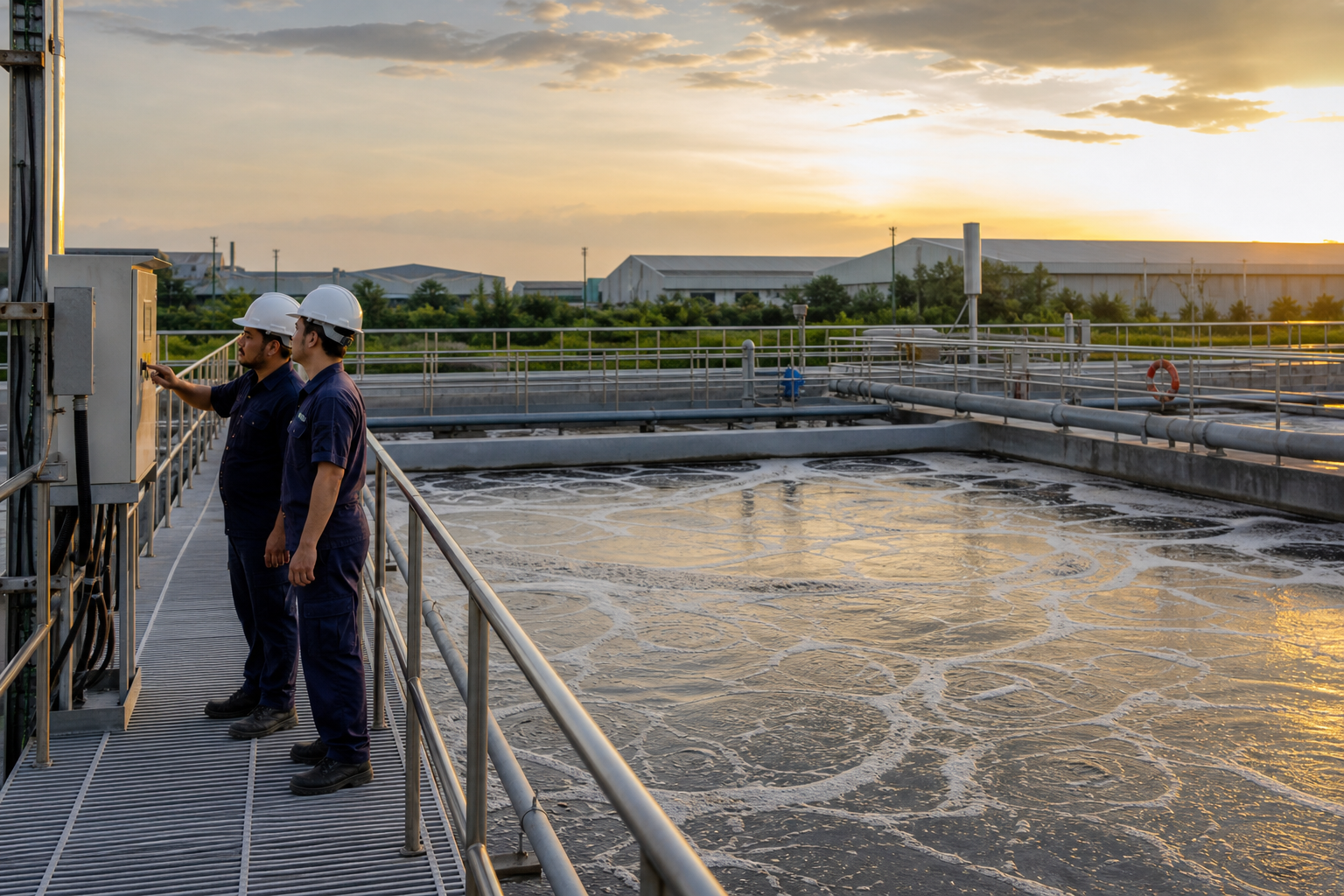
Apartment STPs
Dual peaks, occupancy phasing, reuse, and KSPCB consent packs for Bengaluru layouts.
Direct answer
A sewage treatment plant (STP) treats domestic sewage from residences, campuses, and commercial complexes; an effluent treatment plant (ETP) treats process wastewater from industry with oils, chemicals, or metals needing different unit operations. IE-RISE selects or reviews technology, hydraulics, and KSPCB consent narratives for Bengaluru sites—apartments on constrained sewers and factories discharging to CETPs or reuse.
Hybrid streams need explicit characterisation before design lock-in.
Wastewater source: Apartments, hotels, hospitals, IT campuses
Typical treatment path: STP — biological treatment for domestic sewage; reuse or discharge per consent
Wastewater source: Manufacturing, food, metal finishing, pharma
Typical treatment path: ETP — pretreatment, physico-chemical, biological stages as influent requires
Wastewater source: Mixed domestic and process streams
Typical treatment path: Segregation first; dual trains or dedicated pretreatment before biological polishing
Wastewater source: Zero liquid discharge (ZLD) target
Typical treatment path: ETP plus concentration/reuse train — feasibility before capital commit
Treatment focus
Bangalore combines high apartment density, heterogeneous industrial effluent, and constrained sewer connectivity. STPs must handle variable domestic loads; ETPs must manage COD, TDS, and metals before CETP discharge or ZLD commitments. IE-RISE advises on technology selection, hydraulics, and consent documentation—not generic catalogue plants.
Dual peaks, occupancy phasing, reuse, and KSPCB consent packs for Bengaluru layouts.
Treatability, CETP pre-treatment, and consent-linked design basis reports.
Headroom for expansion and honest high-recovery / ZLD feasibility where required.
Troubleshooting exceedances, odour, and O&M before the next inspection.
KSPCB evaluates STP/ETP designs within CFE/CFO applications—hydraulic profiles, sludge handling, discharge points, and lab protocols. Apartments and hospitals in Karnataka face STP scrutiny at occupancy and renewal.
We prepare treatability summaries and design basis reports evaluators expect.
Large layouts in Bengaluru Urban must demonstrate STP capacity for phased occupancy, dual peaks, and tertiary treatment when reuse is mandated. BBMP and KSPCB interfaces appear in consent conditions.
We review MEP designs, suggest MBBR/SBR/MBR trade-offs, and document O&M requirements for RWAs.
Factories discharging to Karnataka CETPs need robust equalisation, oil removal, and sometimes advanced treatment for difficult streams. Inlet violation fees and consent cancellations follow repeated exceedances.
IE-RISE aligns pre-treatment with CETP charter limits and KSPCB general standards.
Production changes outgrow original ETPs; apartments add towers without STP headroom. Upgrades may trigger KSPCB amendments and fresh commissioning tests.
We feasibility-test ZLD or high-recovery options where Karnataka policy or corporate targets require minimal liquid discharge.
Plants fail when aeration, sludge age, or chemical dosing mismatch actual waste—common after monsoon infiltration or unauthorised trade effluent. Odour complaints invite KSPCB visits.
Our engineers diagnose bottlenecks and specify fixes with realistic downtime plans for Bangalore sites.
Consent conditions specify parameters and frequencies—inlet/outlet COD, BOD, TSS, oil & grease, and sector-specific metals. Labs must use recognised methods.
We design sampling plans and interpret trends for management—not just pass/fail snapshots.
Treated sewage reuse for flushing and landscaping reduces Cauvery demand—a priority for Bengaluru campuses. Integration with rainwater harvesting requires clear water quality routing.
IE-RISE documents reuse in consent and EMP language where EC applies.
We review vendor BOQs, P&IDs, and commissioning protocols so as-built plants match submitted KSPCB drawings—avoiding CFO delays after installation.
KSPCB expects treatability rationale, hydraulic peaks, sludge handling, and discharge standards matched to your route—not catalogue drawings alone.
Combined STP and ETP assignments start from water balance and influent characterisation, then size unit operations for monsoon peaking or shift patterns. Dr. M. Inayathulla leads water-resources and environmental-engineering work at IE-RISE, grounding plant sizing, balances, and compliance narratives in hydraulics, treatability, and defensible monitoring rather than catalogue specifications.
Dr. M. Inayathulla — water resources & environmental engineering
STP handles domestic sewage; ETP handles industrial effluent with process-specific contaminants. Consent conditions and design standards differ accordingly.
Only when streams are compatible or properly segregated. IE-RISE assesses mixing risks before approving combined designs.
Yes. Technical annexures reflect design basis, hydraulic profiles, and monitoring aligned to CFO requirements.
Diagnostics review influent variability, hydraulic short-circuiting, aeration, chemical dosing, and sludge management against design intent.
Zero Liquid Discharge (ZLD) aims to eliminate liquid discharge through reuse, concentration, and evaporation—feasibility depends on economics, energy, and salts balance.
Yes. Pre-treatment and sampling must meet member rules and your CFO conditions simultaneously.
Yes. Independent review checks unit sizing, redundancy, and O&M realism before capital approval.
Take the next step
Share flow rates, sector, current treatment technology, and KSPCB or CETP context.
Built for attribution, intent, and faster follow-up.
Your information is secure and used only for consultation.
What happens after you submit
A senior consultant reviews your requirement and calls you back, usually within one working day.
You get clear next steps on KSPCB consent (CFE/CFO), STP or ETP plant design, and the documents needed.
Prefer to start small? Ask for a compliance checklist, document list, or an approval timeline instead of a call.
“From compliance to cleaner operations — we help you move forward with confidence.”
Call us
+91 8088971526
Speak to our consulting team.
Email us
info@ierise.in
We'll get back to you soon.
Working hours
Mon - Sat: 10 AM - 7 PM
Office
# 3, Dr. B. R. Ambedkar Veedhi, Bengaluru-560 001
Quick queries? Chat with our team.