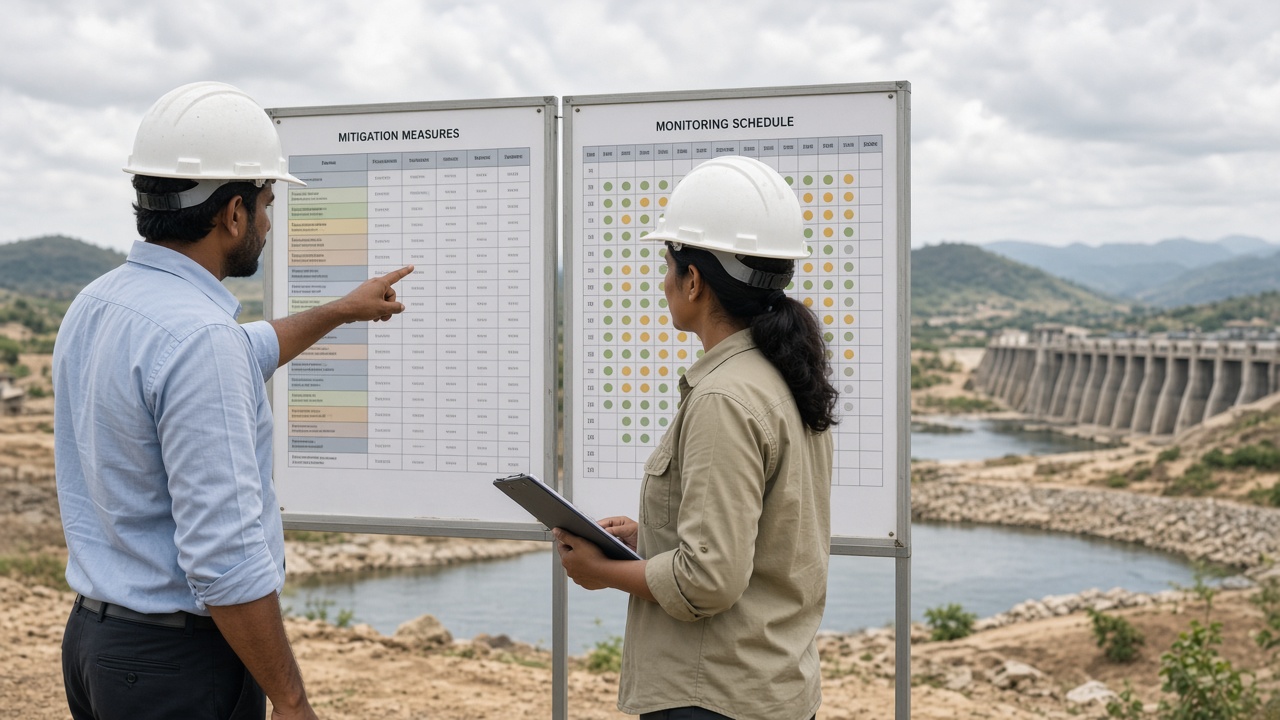

This is a project-planning briefing, not the Environmental Clearance procedure and not the EIA-versus-clearance comparison. Those sit on the process guide and the EIA vs Environmental Clearance page. Use this note when a project director, owner’s engineer, finance lead or in-house EHS team has to decide what to freeze before baseline starts.
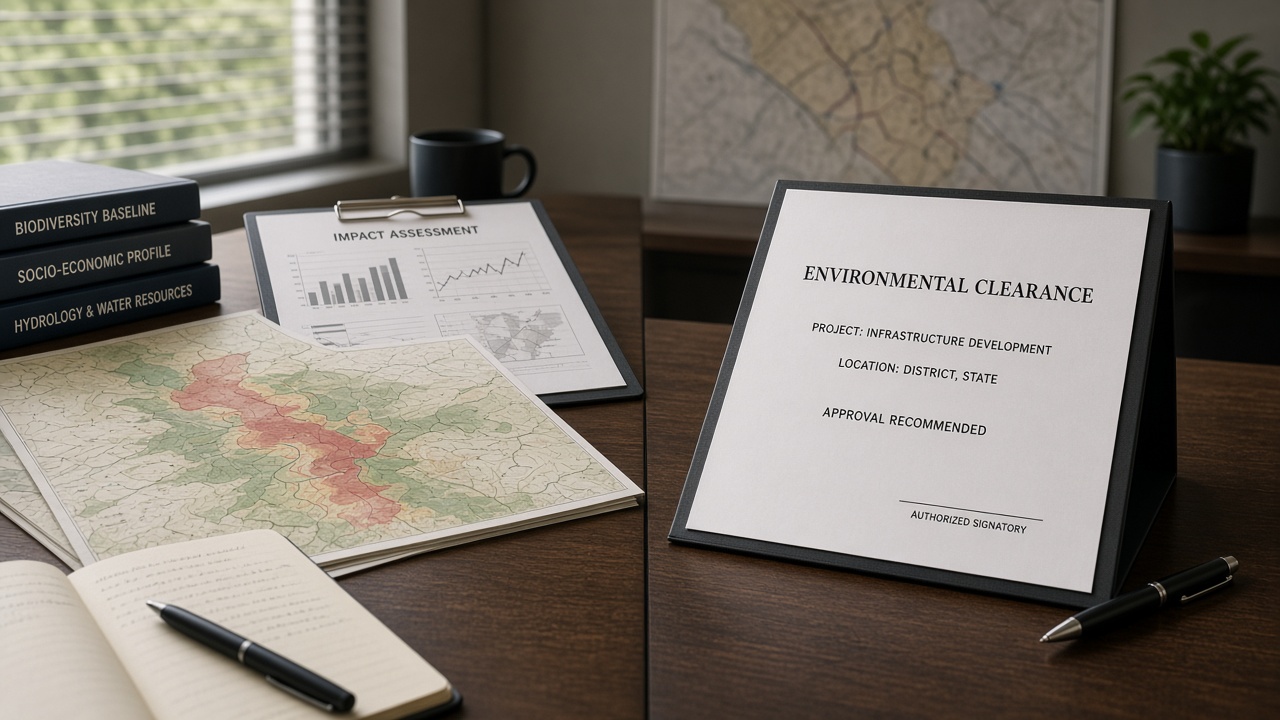
An EIA is an argument: this project, at this site, with this baseline, produces these impacts, and these mitigations are specific enough to monitor. Environmental Clearance is the regulatory decision that follows appraisal of that argument. The expensive mistakes are starting baseline on a description that will change, treating a finished study as permission to build, and leaving KSPCB consent off the same Gantt.
This briefing does not invent thresholds, fees or timelines. Confirm schedule entries on MoEFCC, PARIVESH and SEIAA Karnataka before you commit.
What to settle before anyone defines Environmental Clearance again
Environmental Clearance is the authority’s decision on a scheduled project. The EIA is the study that informs that decision. Whether the project needs clearance at all is an applicability question. Short versions are enough here:
- If you need the definition and the stages, use the Environmental Clearance process.
- If you need the decision tree, use when Environmental Clearance is required.
- If the team is still saying “EIA” when they mean the permit, use EIA vs Environmental Clearance.
Do not use informal rules of thumb. Screen a frozen project description, then re-screen if design changes. Work outside the schedule may still need KSPCB consent.
Planning checkpoints before each EC/EIA stage
Applicability --> Documentation --> ToR (where applicable)
       --> Baseline --> Impact assessment --> EMP
       --> Public consultation (where required)
       --> Appraisal --> EC grant --> Post-EC compliance
The procedure for each stage is the Environmental Clearance process in India. The notes below are what the project team should have decided before that stage starts.
Project screening / applicability
Confirm schedule item, thresholds, category pathway and location overlays. Output: a written applicability rationale and a project description that engineering, finance and the portal filing will all use.
Terms of Reference
Where ToR are issued or prescribed, map every line to a chapter owner, data plan and map. Unanswered ToR items become appraisal queries.
Baseline studies
Collect seasonal and spatial data for air, water, land, noise, ecology and socio-economics as scoped. Stations must match maps; socio-economic work must reach communities that will live with the gate — a frequent gap on Bengaluru fringe and linear Karnataka projects.
Impact assessment
Link construction and operation activities to baseline changes. Keep capacity, fuel and layout consistent across chapters. Disclose residual impacts after mitigation.
EMP
Translate mitigation into avoid–minimise–restore–compensate actions with parameters, frequencies, responsibilities and budget logic. See Environmental Management Plan.
Public consultation where applicable
Treat notices, venue, district coordination and response documentation as a workstream with dates. Record commitments that will later appear in EC conditions.
Appraisal
EAC or SEAC review (as applicable) tests consistency and feasibility. Answer with evidence and revised drawings, not adjectives.
Environmental Clearance
On grant, open a condition register within days. On refusal or deferral, use the record to redesign — do not restart from rumour.
Post-EC compliance
Implement EMP, run monitoring, file reports, keep evidence, and amend for material changes. See Post-Environmental Clearance Compliance.
Common Problems That Delay EC/EIA Projects
- Unfrozen design — capacity or technology changes mid-baseline
- Land / map inconsistency — survey numbers, coordinates and layouts disagree
- Template EIA — generic mitigation, wrong study area, missing seasons
- ToR ignored — specialist studies never commissioned
- Consultation treated as logistics only — responses not reflected in final EMP
- Optimistic Gantt — no buffer for query cycles; civil contracts tied to “EIA draft”
- EC/KSPCB confusion — CFE pursued as if it replaced prior EC
- No post-EC owner — conditions orphaned after celebration of grant
- Vendor EMP — facility contracts that never cite EMP clauses
- Data silos — EC reports and consent monitoring draw from conflicting numbers
How Project Teams Should Prepare
Governance
- Name a single project description owner; change control for capacity and footprint
- Brief the board: “EIA draft ready” ≠ “EC letter in hand”
- Put EC, EMP and KSPCB tracks on one integrated schedule
Technical habits
- Freeze design before baseline seasons
- Write mitigation as owner + parameter + frequency + evidence
- Index every portal upload; version maps and balances
- Plan lab and consultant scopes against ToR, not against a marketing brochure
Karnataka sequencing
- Align SEIAA Karnataka / MoEFCC pathway with land and finance gates
- Parallel-plan KSPCB CFE/CFO so commissioning is not blocked after EC
- Expect location-specific questions on coastal, forest-proximate or dense urban-edge sites — prepare maps early
Readiness pack before consultant kickoff
- One-page project description with units matching the schedule language
- Land documents and geo-referenced layout
- Prior EC / consent history for expansions
- Known sensitive receptors and water sources
- Draft organisation for environment cell and reporting
Training and literacy help teams challenge weak drafts; they do not replace statutory clearance. IE-RISE Research Desk and consultancy support focus on making the file honest enough to survive questions — then implementable after grant.
Related reading and services
Common questions
What should a project team freeze first?
A coherent project description (capacity, layout, process, location) before baseline and EIA drafting. Rewriting the description mid-study is a planning failure, not a reason to open a second process guide.
Is this the Environmental Clearance process?
No. This briefing is about early project-planning decisions. The staged procedure is the Environmental Clearance process guide. The difference between the study and the clearance decision is the EIA vs Environmental Clearance page.
Official sources
PARIVESH
EC/EIA application workflow, notifications and compliance reporting
Ministry of Environment, Forest and Climate Change (MoEFCC)
EIA Notification framework and amendments
EIA Notification, 2006, consolidated as amended up to July 2026 (PARIVESH)
compilation only; the Gazette text prevails if they differ
EIA Notification, 2006, S.O. 1533(E) dated 14 September 2006, paragraph 9 as substituted by S.O. 1807(E) dated 12 April 2022 in that compilation
validity differs by project class
SEIAA Karnataka
state-level appraisal pathway where Category B applies
Confirm current schedule entries, forms and ToR practice on official channels before filing