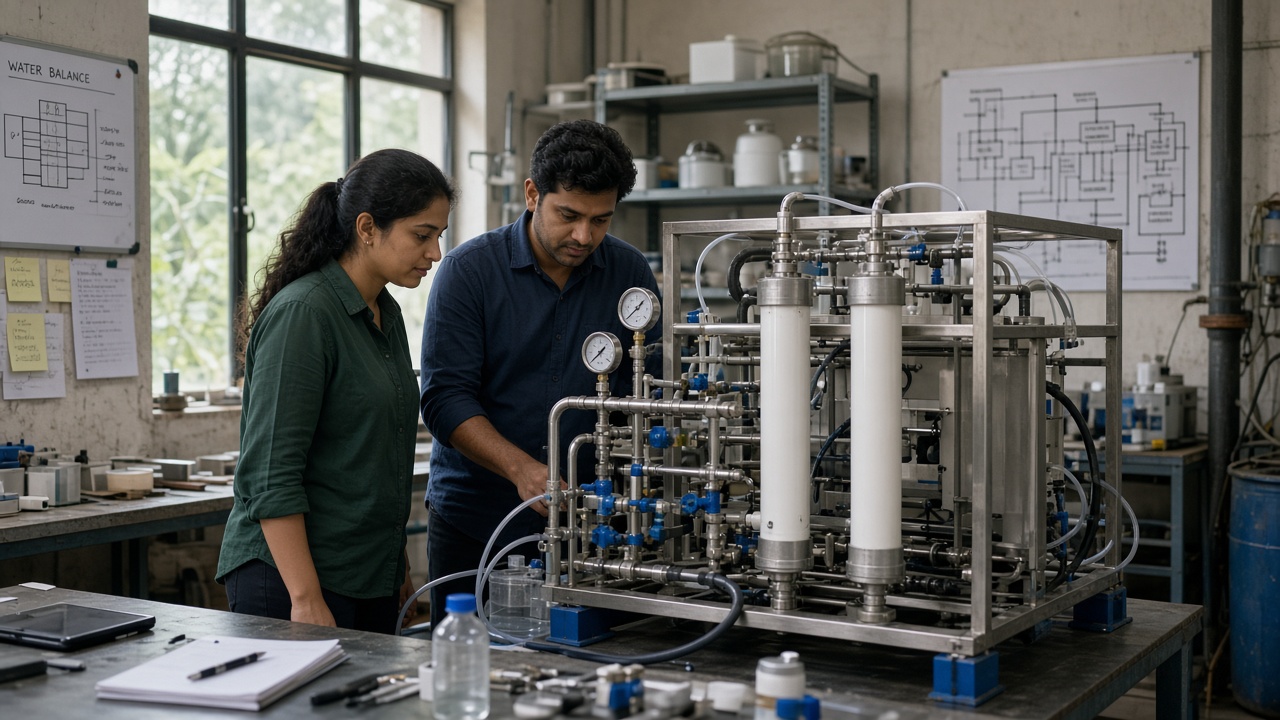
Environmental problems become enterprises when someone can turn a waste stream, resource gap or monitoring failure into a product or service that customers pay for — and that can survive procurement, operations and regulation.
This page is about environmental entrepreneurship and green ventures in India. It is not a consultancy keyword page.
What Makes an Environmental Problem Commercially Relevant?
A problem is commercially relevant when:
- someone already pays for a poor workaround (tankering, fresh water purchase, disposal fees, downtime)
- regulation or customer contracts raise the cost of doing nothing
- the technical solution can be packaged, priced and supported
- the founder can access the site where the problem lives
“Important for the planet” is not enough. “Painful for a budget holder with a purchase path” is the starting point.
From Compliance Problem to Business Opportunity
Many ventures begin where compliance is expensive or unreliable: treatment underperformance, missing monitoring, weak reuse, sludge outlets, or data that plants cannot defend. Compliance pressure creates demand; it does not automatically create a business model.
Translate the pain into an offer:
- what unit of value do you sell (treated m³, uptime, verified data, recovered product)?
- who signs the cheque (facility, EPC, municipality, estate)?
- what proof do they need (test certificates, pilots, references)?
- what consent or standard will sit next to your claim?
Founders who understand the science but underestimate operations, procurement and regulation fail in the same place every time.
Examples of Environmental Enterprise Opportunities
Illustrative opportunity spaces — not IE-RISE client claims:
- modular pretreatment or polishing for variable industrial streams
- monitoring hardware and services that produce audit-ready records
- sludge or salt handling solutions with clear disposal pathways
- water reuse packages matched to non-potable uses plants already need
- decision tools for climate or flood risk where insurers and lenders ask better questions
- circular materials that replace a virgin input with verified quality
Each space still needs site attachment: a CETP struggling with a parameter, a city that cannot see its drains, a factory paying for water it could recover.
Technology, Regulation and Market Demand
Green ventures sit at a three-way intersection:
- Technology — does it work at real influent and real duty cycles?
- Regulation — can the claim be stated without inventing approvals?
- Market — is there a buyer with budget and a path to deploy?
Ignoring any one leg produces either an unlicensed science project or a brochure without sales. Institutional programmes can help founders pressure-test all three; they do not replace statutory permissions.
How to Validate a Green Venture
- Name the waste stream or resource gap with numbers from a real site.
- Identify the economic buyer and the current workaround cost.
- Map the compliance path — consent conditions, standards, test methods — without inventing certificates.
- Run a bounded pilot with success metrics the buyer accepts.
- Check unit economics including O&M, not only CapEx.
- Stress-test procurement: who must approve a new vendor inside the facility?
Bring a problem with a site attached. Be ready to talk about the officer or auditor who will ask for a test certificate.
IE-RISE Incubation and Innovation
IE-RISE incubation is built for founders crossing from environmental problem to venture: mentors, labs and industry partners help shape the idea, pressure-test the process, and prepare for funding conversations — without pretending that an institutional programme is a licence to operate.
Knowledge, skills, innovation and enterprise are a sequence this centre was set up to run. The knowledge hub returns to that sequence in applied articles; the incubation desk is where it becomes a company.
Have an environmental technology or sustainability venture idea? Explore IE-RISE incubation through Contact and centre programmes listed on the IE-RISE site.